
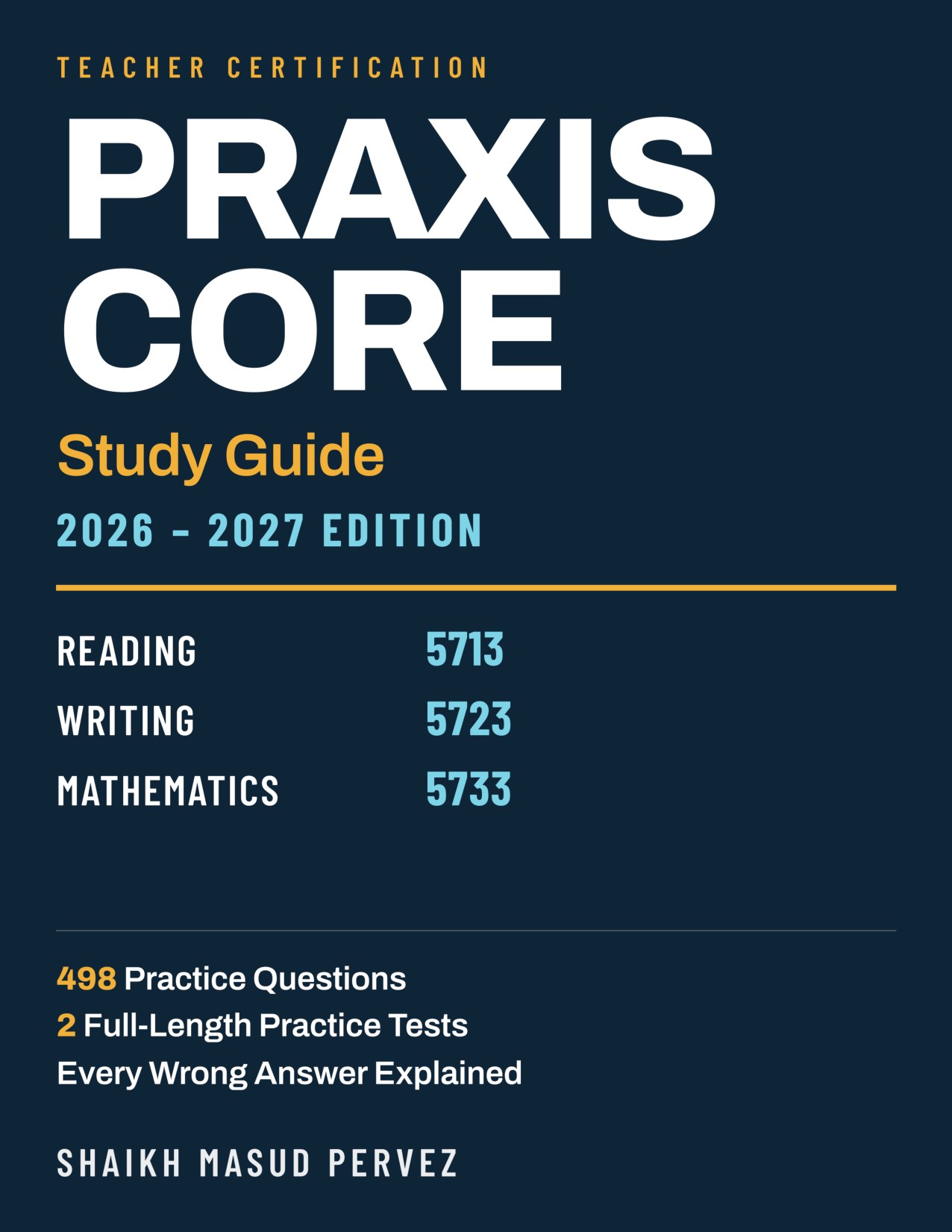
Praxis Core Study Guide 2026-2027
Reading 5713, Writing 5723, and Mathematics 5733 with 498 Practice Questions and Two Full-Length Practice Tests
What is inside
- 18 instructional chapters, mapped objective by objective to the specifications ETS publishes for Reading 5713, Writing 5723, and Mathematics 5733
- 498 practice questions, every one written for this book
- Two full-length practice tests - 112 reading questions, 80 writing questions, 112 mathematics questions, and four essay prompts
- Both essays taught with complete model responses - a high-scoring version and a middling one, printed side by side, with a plain account of exactly what separates them
- Two study plans - four weeks, and two weeks when that is all you have
- A formula and conversion sheet written to be reread on the morning of the exam
Three tests. One sitting. And the subtest that costs you points is rarely the one you feared.
Most candidates walk into the Praxis Core worried about mathematics and lose their points in Writing, where the errors are subtle and forty questions arrive in forty minutes. This guide is built so that you find that out before test day does.
WHAT IS INSIDE
WHY THIS BOOK IS DIFFERENT
Most guides tell you the answer is C. This one tells you why B was written to attract you, and which specific mistake puts you there. Every explanation names the trap, because the Praxis reuses a small number of trap structures and learning to recognize them is worth more than learning additional content.
A WARNING ABOUT DIFFICULTY
Some preparation books make their practice questions easier than the real examination. It produces a satisfying study experience and a bad test day. The questions here are written to sit at or slightly above the difficulty of the real test. If a practice set feels harder than you expected, that is deliberate. A score on these tests should not flatter you.
BUILT FROM THE SOURCE
Every objective was mapped from the specifications ETS publishes. Every answer was worked twice. Every incorrect option was written to represent a mistake a real candidate makes, rather than to fill a slot.