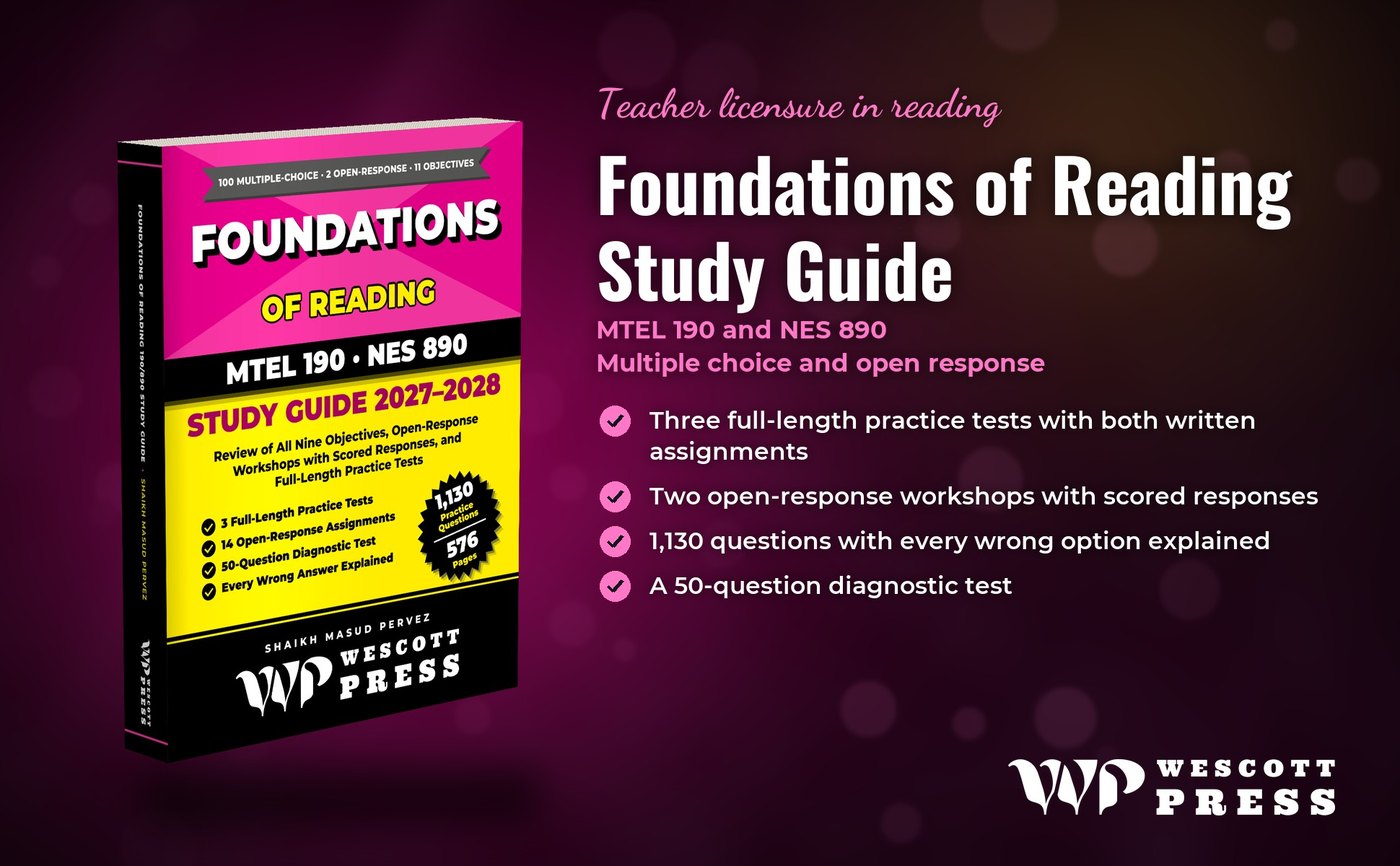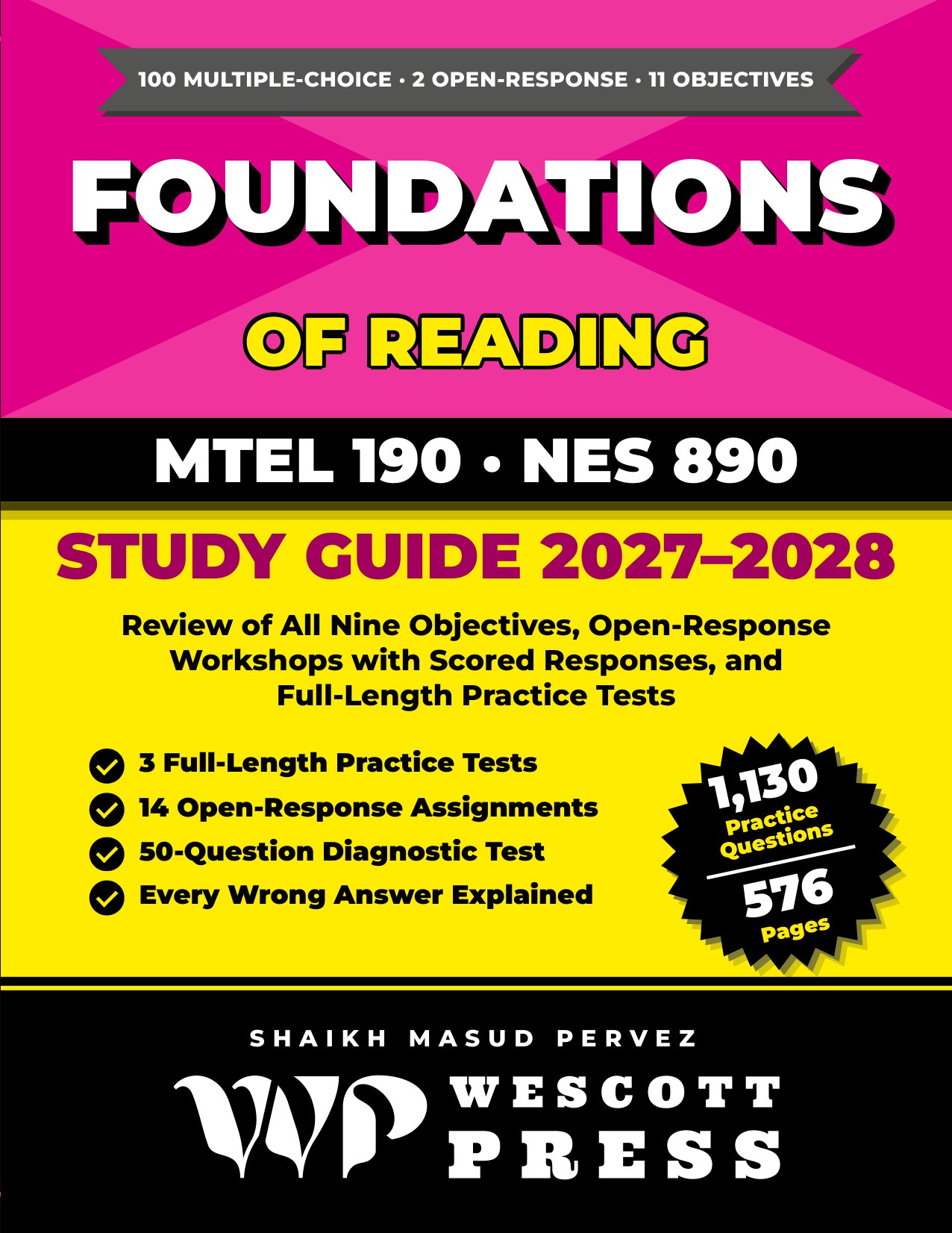
Foundations of Reading (190/890) Study Guide
Review of All Nine Objectives, Open-Response Workshops with Scored Responses, and Full-Length Practice Tests
What is inside
- 1,130 practice questions, each with the reason for the right choice and every wrong one
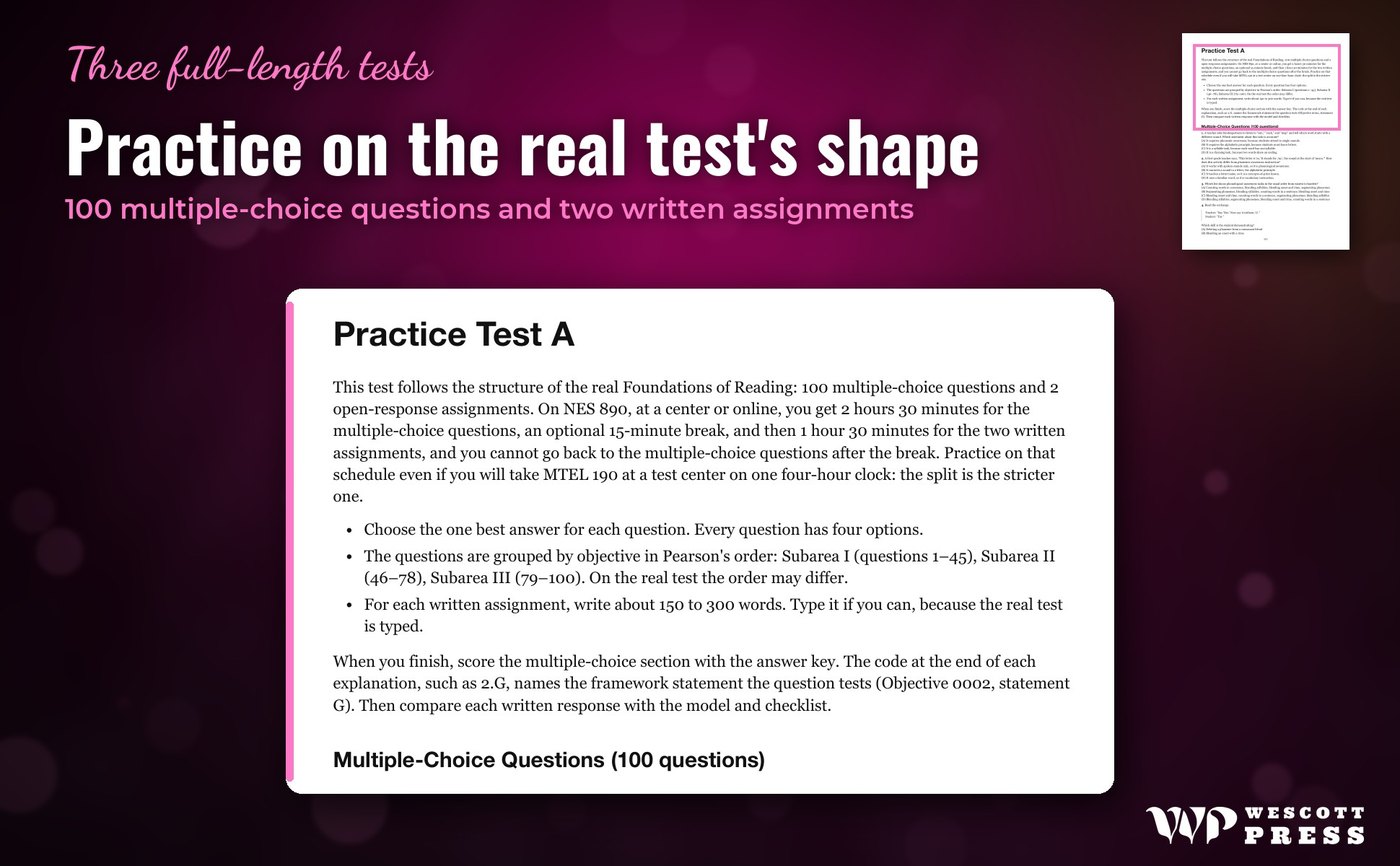
- Three full-length practice tests, each with 100 multiple-choice questions spread across the subareas as Pearson does, plus two open-response assignments
- Two open-response workshops with a worked case scored 4, 3, 2, and 1, three practice cases, and model responses with checklists
- A 50-question diagnostic test that sends each missed question to its chapter
- Running records, fluency summaries, spelling samples, and retellings to analyze, as the test presents them
- Passing scores for the 21 states on Pearson's list, with the timing for each code and way of testing
- Quick reference, confused terms, glossary, coverage map, answer key at a glance, score tracker, and wrong-answer log
For the 2027–2028 testing year: Foundations of Reading (MTEL 190 and NES 890) taught one framework statement at a time, with three full-length practice tests and 14 open-response assignments.
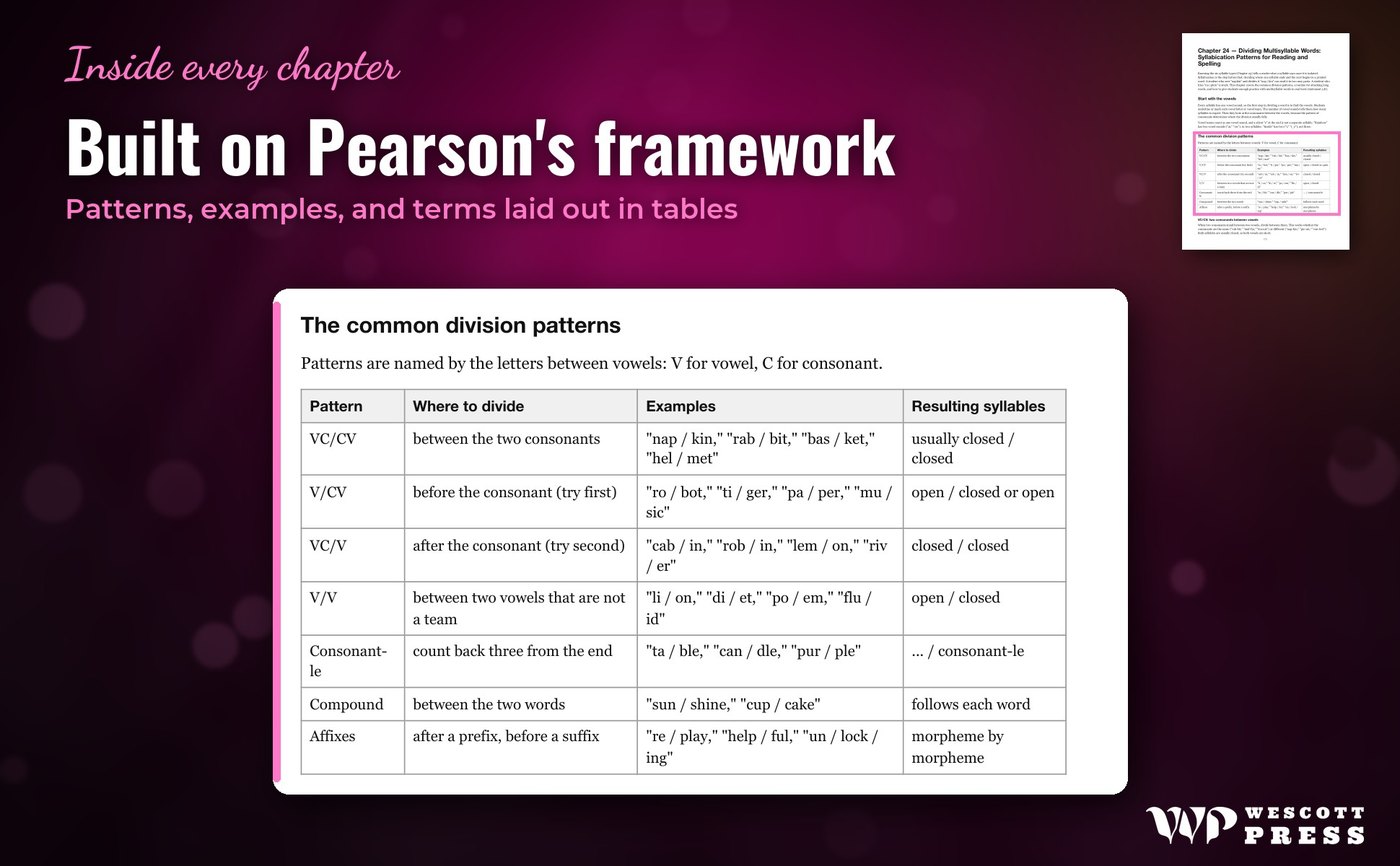
Foundations of Reading is the Pearson test that a growing list of states uses to check whether new teachers know how children learn to read. Massachusetts gives it as MTEL Field 190, Ohio as OAE 190, and most other states as NES Field 890. The content is the same under every code: 100 multiple-choice questions in three subareas (foundations of reading development, about 35% of the score; comprehension, 27%; assessment and instruction, 18%) and two open-response assignments worth 10% each. This book follows Pearson's framework in that order, from Objective 0001 to Objective 0011.
Written for the questions this test actually asks. Most items describe a child, a reading record, or a spelling sample and ask what a teacher should notice or do next. The 65 teaching chapters show how to read that evidence: why a student who writes "jumpt" for "jumped" hears the ending correctly but does not yet know the -ed spelling, when a slow oral reading points to decoding rather than speed, which syllable type explains a misread vowel, and how to pick a strategy for students who can name the topic of a passage but not its main idea. Every teaching chapter ends with 12 practice questions.
What is inside
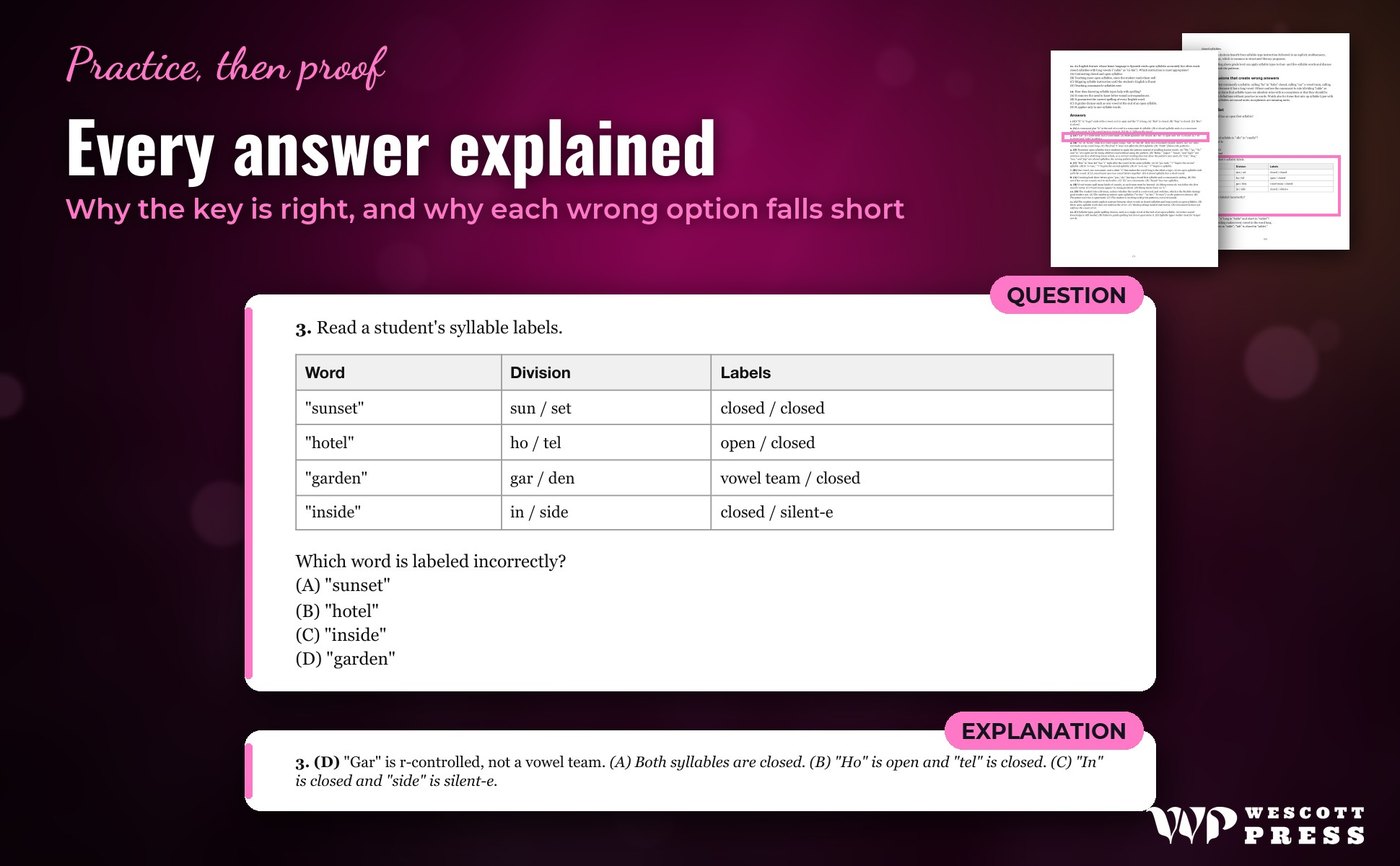
- 1,130 multiple-choice practice questions, each with a line on why the answer is right and a line on every wrong choice
- Three full-length practice tests of 100 questions each, spread across the subareas as Pearson does, plus two open-response assignments per test
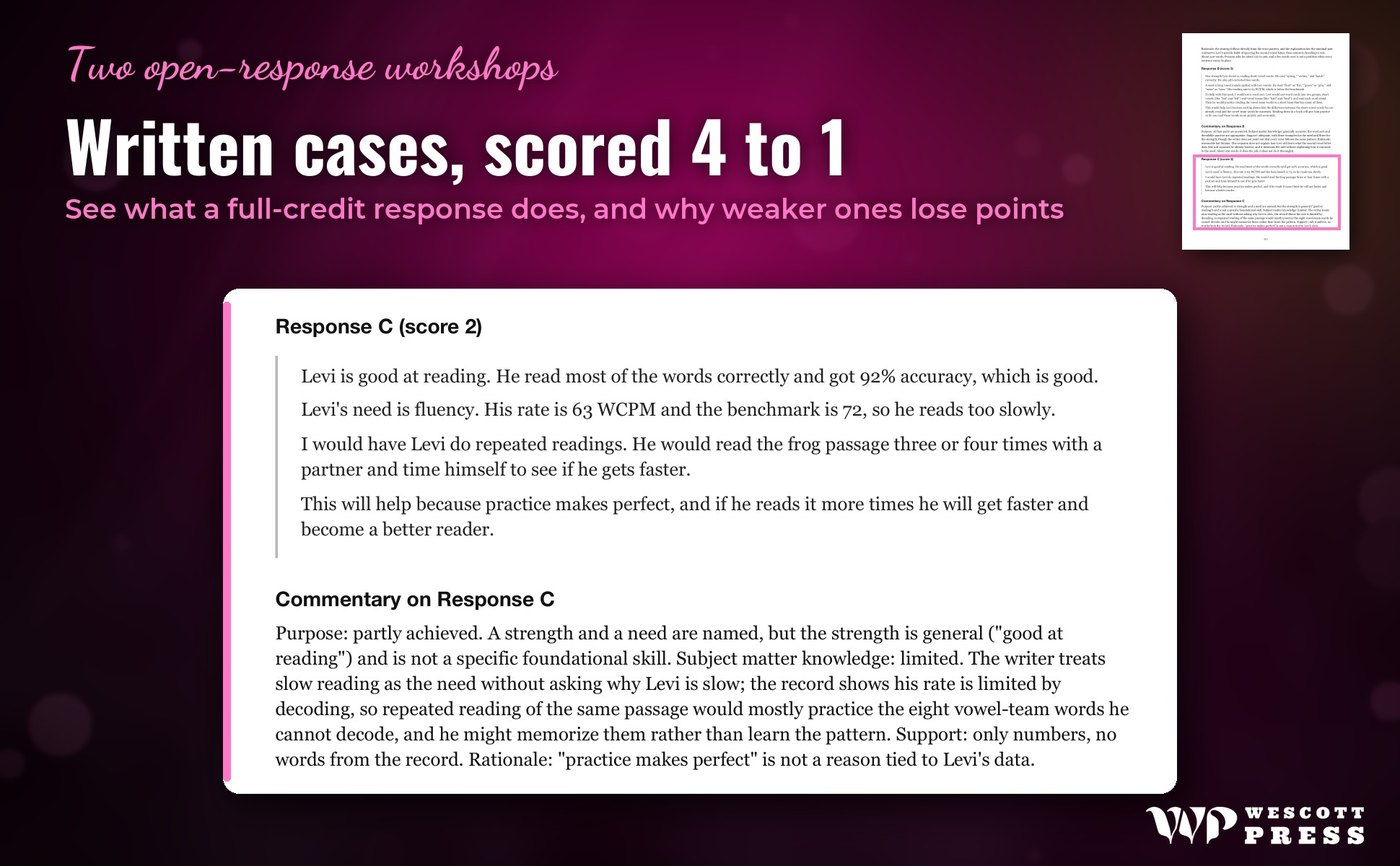
- Two open-response workshops, one on foundational reading skills and one on comprehension, each with a worked case scored 4, 3, 2, and 1 and three practice cases with model responses and checklists
- A 50-question diagnostic test that points each missed question to the chapter that teaches it
- Running records, fluency summaries, spelling samples, and retellings to analyze, laid out the way the written assignments present them
- The research the framework rests on, in plain words: the National Reading Panel, Ehri's phases of word reading, the Simple View of Reading, and Scarborough's Reading Rope
- Review tools: a quick reference, confused terms, a glossary, a topic coverage map, an answer key at a glance, a score tracker, and a wrong-answer log
190 or 890, and your passing score. Chapter 2 explains which code your state uses and lists the passing scores on Pearson's October 2026 list for 21 states: 240 in fourteen of them, 233 in Alabama, Arkansas, Mississippi, North Carolina, and Wisconsin, 224 in California, and Ohio's own OAE scale. Chapter 1 sets out the timing for each code and way of testing, including the 890 schedule that closes the multiple-choice section at the break.
Checked at the source. The question counts, subarea weights, timing, the four-point scale for written responses, the $139 fee, the retake rules, the 100 to 300 score scale, and state passing scores were read from Pearson's test framework, test pages, official practice test, and state list in October 2026.
Not affiliated with or endorsed by Pearson. Foundations of Reading, MTEL, and NES are tests and programs of Pearson Education, Inc. or its affiliates, which have not sponsored or endorsed this product.